Abstract |
| A summary of an article, a video or a book. See our How-to Guide on abstracts for more information. |
Academic journal |
| See: Peer reviewed |
Annotated Bibliography |
| A brief explanation (ranging from 2 or 3 sentences to 2 or 3 paragraphs) accompanying a reference or citation describing the scope or content and critical analysis of a particular work. See our How-to Guide on Annotated Bibliographies for an example and more detailed explanation. |
AnthologyA compilation of writings or poems from one or more authors focusing on a particular subject or literary form. APA citation styleGuidelines, developed by the American Psychological Association, for preparing and formatting research papers and referencing sources in the behavioral sciences. APA is the preferred citation style for disciplines including business, nursing, psychology etc. For more about APA style, see our Citing Sources Research Guide. See also: MLA Citation Style, Citation ArticleA piece of writing on a particular topic. An example would be an encyclopedia article or a magazine or newspaper article. |
Article Database |
|
A searchable collection of articles from hundreds of thousands of scholarly journals and other sources. Libraries typically pay a licensing fee to publishers such as EBSCO in order to give users access to search for and download articles from databases (i.e., JSTOR, Academic Search Premier, etc.). Here is a complete list of Databases available through the Consortium Library. |
Ask Us |
| Access to "live" librarians at the UAA/APU Consortium Library. They are happy to answer questions about research, citing your sources, accessing library collections from off-campus, printing at the library, checking out books, using study rooms, and more. Visit our Ask Us page to reach us via chat, email, phone, text, or in person. |
Authentication |
| A security system to identify an individual using a computer, usually based on a username and password. |
Call Number |
| A combination of letters and numbers indicating the specific shelf location of a work in the library. Example: PG 3326 .P72 A3 1980 |
Catalog |
| A list of books, Ebooks (though not all), DVDs, periodicals that are located in the library catalog. Note that because Alaska has a shared catalog, you will see items from other libraries around the state. You can place holds on most of these items and have them sent to the Consortium Library for pick up. See also: QuickSearch |
Catalog Record |
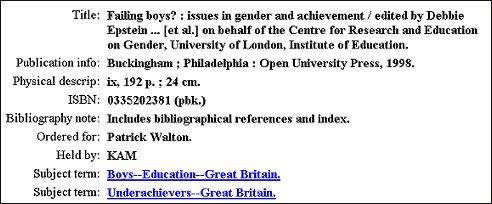
| A record which appears in an online catalog that represents a book, journal or other item housed within the library. The record includes the bibliographic description of a specific item, the location of the item within the library, and the status of the item (checked out, available, etc.). |
Circulation Desk |
| The Main Circulation Desk is the place to check out and return library material, pick up holds, and check out course reserve readings. See our Student Services page for more information about library services |
Citation |
| The information needed to track down a book, article, or other work. For books, this includes the author, title, place and year of publication. For articles, it consists of the author, article title, page numbers, periodical title, volume and date. Citing is the act of giving credit to an original source. Citations usually follow a particular format called a style (e.g. APA citation style, MLA citation style). |
Cited by |
| The number of times a work or author has been referred to, or cited by, by another author, and where. |
CopyrightThe legal protection of the owner or creator (e.g. author, artist, etc.) of an original work (e.g. literary, artistic, etc.) to publish, reproduce, distribute, sell, or otherwise use the work. The copyright owner can also permit or prevent anyone else from using the work. For more information, see our guide about Copyright & Fair Use. |
Corporate Author |
|
All or part of the name of a corporate group or government agency responsible for creating a document, book, report, journal article, etc. (e.g. World Health Organization (WHO), National Aeronautics and Space Administration (NASA), Bureau of Land Management (BLM), etc.) |
Course Reserves |
|
Materials placed by instructors at the library for the use of their students. These materials are available for check out at the Main Circulation Desk. See our Course Reserves guide for more information. |
Cross-Reference |
| Cross-references are usually found in library catalogues, subject lists and thesauri. They are directions that lead you from one subject or name to the preferred one that is used in a catalogue or index. Cross-references can also lead you to broader, narrower and related terms. |
Example: Body Language |
Database |
| An organized, searchable collection of information, often related to a specific subject area. One of the primary tools for locating periodical articles by topic. Most databases available through the library are licensed resources with access restrictions. |
Descriptor |
| See: Subject Heading |
Discharged |
| An item that has been returned to the library and checked in. The item will be on a book truck or returned to the shelves. |
Document Delivery |
| A service that allows you to order items held in the library's print collection including book chapters and journal and newspaper articles. When you place an order for an article, we will find it in the print collection, scan it, and deliver it to you electronically. Visit our Interlibrary Loan guide to find out more. See also: Interlibrary Loan |
DOI |
| DOI stands for Digital Object Identifier. DOI is a system of naming an object, similar to a URL for a webpage e.g. http://dx.doi.org/10.1589/jpts.27.361 (opens in a new tab). Unlike webpage URLs that can change, DOIs are permanent URLs. See also: Persistent Links |
Due Date |
| The date by which borrowed materials must be returned to the library. |
Electronic Book (Ebook) |
|
A book that has been digitized and is available to read through the Internet. They are sometimes referred to as Ebooks, online books, or digital books. See our Ebooks Guide for more information about finding and downloading Ebooks. |
Electronic Journal (Ejournal) |
| An electronic journal that provides its content over the Internet. Some are accessible to anyone (See: Open Access), but many others require purchase of a subscription. We maintain access to thousands of Ejournals through our subscription databases. You can search for a specific journal title here. |
Hold |
| A "hold" ensures that a library item on loan to another patron will be saved for you when the item is returned. Placing a hold is also a way to move a book between libraries across Alaska. When searching in the traditional library catalog, you will need to log in with your UAA/APU credentials to place a hold. If you're searching in QuickSearch, clicking on the title of the item will route you to the catalog, where you will be able to place a hold on the item. See also: Catalog |
Holdings |
| A library's collection of materials. Items owned by a library (e.g., books, journals, newspapers, etc.). |
In-text citation |
| Refers to a source that is referenced within the text of a paper, rather than in footnotes or endnotes. Brief information about the resource leads the reader to the full citation for the source listed at the end of the paper. Also known as parenthetical citation, parenthetical reference or a narrative citation. |
Interlibrary Loan |
| Interlibrary loan is the sharing of materials between libraries. When a library user needs material that is not available at at the Consortium Library or another library in the state of Alaska, they can usually obtain it through interlibrary loan. See also: Document Delivery |
Index |
| An alphabetical list of names and subjects, with relevant page numbers, found at the back of most scholarly books. A useful finding aid to the contents of a book. |
ISSN |
| International Standard Serial Number. A unique number used to identify serial publications such as magazines and scholarly journals. Can be confused with a DOI but do not include it in a citation. |
Issue |
| A single copy of a periodical. For example, the New Literary History journal publishes 4 issues per year. |
LibGuidesSee: Research guides |
Library of Congress Subject Headings (LCSH) |
|
A controlled vocabulary used to describe the contents of works in the library. Materials classified with Library of Congress call numbers use these subject headings. Subject headings form an important part of the library catalogue record and are used to search for items by topic in the online catalogue. |
Loan Period |
|
The amount of time you may borrow a book or other item from the library. The time varies depending on the type of material borrowed. |
A format prescribed by the Modern Language Association for formatting research papers and citing sources in the humanities. A MLA style guide is available from the Library's website. For more about APA style, see our Citing Sources guide See also: APA Style, Citation
Magazine |
| A popular interest periodical usually containing articles on a variety of topics. Most magazines are heavily illustrated, containing advertising and are printed on glossy paper. Articles are usually short, frequently unsigned, and do not include a bibliography or references for further readings. |
Media |
| A generic term for non-print library materials (films, slides, videorecordings, audiorecordings, CD-ROMs, DVDs, etc.). |
Monograph |
| A book that stands complete on its own and is not intended to be produced in series. See also: Serial |
Off-Campus Access |
| Allows you to access online content and other services. Login in with your UAA or APU username and password. |
Open Access (OA) |
| Items of scholarly work (i.e. publications and data) that are made available online in a digital format at no charge to the reader and with limited restrictions on re-use. |
A process through which manuscripts submitted to a journal are evaluated for quality by one or more subject experts in addition to the editor before being accepted for publication. Also known as refereed, scholarly or academic.
A publication with a distinctive title, which appears in successive numbers or parts at stated or regular intervals. Includes journals, magazines, newspapers, or newsletters e.g., Journal of Abnormal Psychology, The Atlantic, New York Times. More information can be found on our Types of Sources guide.
Persistent links, permalinks, or stable links are permanent URLs to a specific journal or article within an electronic article database that can be saved and used for future reference. They are dedicated URLs that do not change.
In article databases, phrase searching allows you to combine keywords so that you only retrieve records in which the keywords appear next to each other in the order specified. To do this, surround the phrase with double quotations e.g., "hazardous waste".
An acronym which stands for Personal Identification Number, a code used for identification purposes in automated systems. Typically, the PIN is created by the system and can be changed by the user. PINs are used in many libraries and library systems to verify that a user is authorized to view his/her circulation account, renew books, place holds etc. If you don't know you PIN, you can contact the Main Circulation Desk at 907-786-1871, option #3 on the phone tree.
Using another person's ideas or exact wording without proper documentation or representing someone else's creative work (ideas, words, images, etc.) as one's own, whether intentional or not, is known as plagiarism. See our Research Guide about Academic Integrity & AI for more information.
Material that provides a first-hand account of a subject or event. Examples include theses and dissertations, diaries, photographs, interviews, and original research studies. Sometimes referred to as original sources or source material. See our guides about Primary Sources and Types of Sources for more information. See also: Secondary Source, Tertiary Source
See: Trade publication
QuickSearch is the Consortium Library's name for EBSCO Discovery Service, the main search box on the library's home page. This search tool finds items from the library catalog and many (not all!) of our databases. It presents one list of many types of information sources including journal articles, conference papers, books, Ebooks and more.
Record |
| The entry for a book, journal article or other piece of information in a database. Normally contains bibliographic information such as the title, author, and publisher information for the item. See also: Bibliographic Description |
RefereedA publication containing articles that have undergone peer review. |
Reference |
| 1) Sometimes used synonymously with citation, reference is used to refer a person to works cited or quoted within a document or to another part of the document (i.e. an index). 2) In libraries the term reference may be used to describe the type of assistance a library staff person may provide. See: Research and Information Help Desk |
Reference Book |
| A book designated to be consulted when authoritative information is needed. Reference books are typically: almanacs, atlases, bibliographies, concordances, dictionaries, indexes, manuals, research guides, yearbooks and may include government documents. Reference books do not leave the library. |
RefWorks Freemium |
| A free, open-source reference/citation manager. See out How-to Guide about Citation Tools for more information. See also: Zotero |
Research Article |
| The primary purpose of a Research Article is to present original findings, though these articles will also include a bibliography of other literature reviewed. These articles will usually be published in peer-reviewed journals and can be identified by looking for the following elements: an introduction, description of the research design, discussion of the data and methods, and bibliography. They are also sometimes referred to as “empirical studies.” |
Research & Information Help DeskIt is the place to go when you need help using the library. Also known as the Reference Desk or Information Desk. Visit the Ask Us page for more ways to contact us! Research Guides |
| A guide designed to assist the user in researching a particular discipline, topic or specific course. Will often include important reference books, periodical indexes, journals and other resources available at the library. Selected web resources are usually also included. |
Review Article |
| A secondary source that reports and summarizes other authors’ works for the purpose of reviewing the state of the literature on a particular topic. Review articles contain helpful bibliographies and can be excellent sources for identifying additional articles in an area of study. |
Scholarly |
|
See: Peer-reviewed |
Search Query |
|
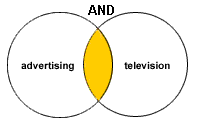
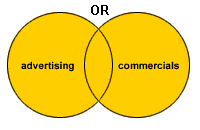
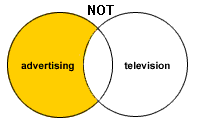
The words or phrases used to conduct a search in periodical indexes, library catalogues, and the web. Sophisticated search queries includes Boolean Logic, wildcards, and truncation. |
Secondary Source |
|
Works that are published or unpublished that rely on original research of primary sources as the source of their information. Examples include textbooks, edited works, books and articles that interpret or review research works, histories, biographies, literary criticism and interpretation, reviews of law and legislation, political analyses and commentaries. See our guide about Primary vs. Secondary Sources for more information. See also: Primary Source, Tertiary Source |
Serial |
|
Publications in any format that are published in a numerical or chronological sequence. They may appear in regular or irregular intervals and are intended to be produced indefinitely. Serials include newspapers, journals, annuals (reports, yearbooks, etc.), and proceedings. See also: Periodical |
Stacks |
|
The area of the library that contains the books. |
Subject Heading |
|
The most specific word or phrase that describes the subject or the "aboutness" of an item. Subject headings are selected from a list of preferred terms that may vary from database to database. For example, the subject headings used in a nursing database will differ from the subject headings used in an education database. |
Tertiary Source |
| A tertiary source is an index or textual consolidation of already published primary and secondary sources that does not provide additional interpretations or analysis of the sources. Examples include Dictionaries/encyclopedias (may also be secondary), almanacs, fact books, Wikipedia, bibliographies (may also be secondary), directories, guidebooks, manuals, handbooks, and textbooks (may be secondary), indexing and abstracting sources. See also: Primary Source and Secondary Source |
Thesaurus |
|
1) A list of synonyms that frequently includes related terms and antonyms |
Trade publication |
|
A journal or magazine that contains articles targeted to people working in a particular profession, trade or industry e.g., ENA Connection is a publication intended for Emergency Nurses and members of the Emergency Nurses Association (ENA). |
Truncation |
| Symbols that can be used to expand search queries. The * is one of the most common truncation symbols. It is a good habit to always check the HELP feature of any catalogue or index to verify the symbol used. See also: Wildcard |
Example: |
Virtual Reference |
| See: Ask Us |
Volume |
| All the issues of a periodical published during a given publishing period (usually a calendar year). |
| Wildcard |
|
A form of truncation. The symbol is used within a word to retrieve variant spellings. It is a good habit to always check the HELP feature of any catalogue or index to verify the symbol used. See also: Truncation |
Example: |
| Zotero |
| A free, open-source reference/citation manager. See our How-to Guide about Citation Tools for more information. See also: RefWorks Freemium |
*This Index was adapted from the Thompson Rivers University Library Glossary of Library Terms Guide.
 Library Account
 Off-Campus Access
 Ask Us